We install meters whose readings can be taken without access to the apartment. Before that, we establish whether it will actually work in your building.
Submitting readings is not difficult in itself, but across a building it creates constant friction. Some residents submit their readings on time, some forget, and some submit them on different dates. As a result the building's total consumption and the sum of the apartments do not match, and the difference ends up on the bills.
Remote reading resolves this not because the device is more modern, but because all the readings are taken at the same moment and without anyone being involved. That removes both forgotten readings and dates that cannot be compared.
The second problem it solves is access. In apartments where nobody is at home, and at properties where the meter sits in a locked room or a well, taking a reading otherwise requires a separate visit.
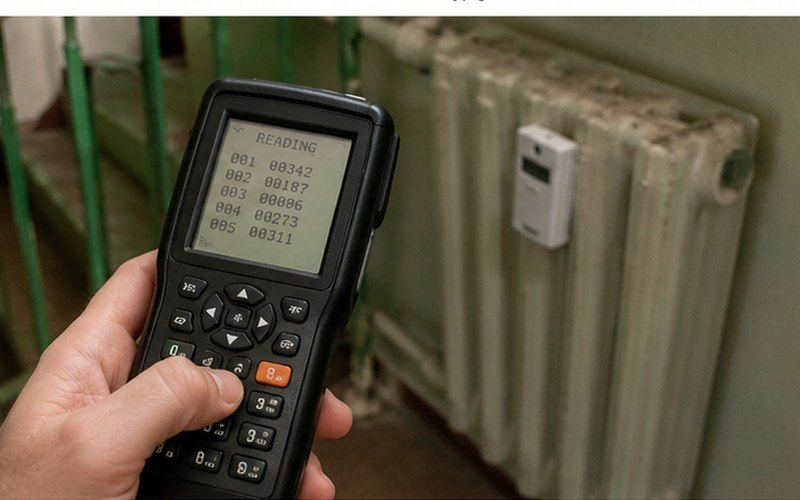
A meter with a radio module transmits its reading at regular intervals. How that reading is received depends on the solution chosen. At its simplest, the readings are collected by walking past with a handheld unit — no need to enter the apartment. In the fuller version a fixed reading unit is installed in the building and collects the readings automatically.
It is important to understand that the meter and the reading system are two separate things. A remotely readable meter without a system to receive the readings works like an ordinary meter — the reading simply has to be taken from the dial.
That is exactly why, before installing anything, we always establish how reading is done in your building and whether a system already exists. Without that, there is a risk of paying for a feature that goes unused.
We establish which system the building has or is planning, and whether the signal will work on site.
We select meters compatible with the reading solution chosen.
Fitting in the apartments to an agreed schedule, with a certificate for each property.
Device numbers, readings and a consolidated report for the property manager.
In a single apartment a remotely readable meter brings limited benefit: if the rest of the building submits readings manually, the overall picture does not change. The system starts to work when it covers the whole building, or at least most of the apartments.
So in practice this service is most often a property manager's decision rather than an individual owner's choice. And that is also why the hardest part of the project is not technical — it is the schedule, the resident notifications and those apartments where nobody opens the door.
We have described how projects like this run in the section on working with property managers. We write about the devices themselves in more detail in the section on smart water meters.
A building's move to remote reading happens gradually, and it rarely starts with buying devices. The first step is to work out which system will be used and whether it will work in that particular building — thick walls, basement assemblies and metal structures all affect how far the signal reaches.
The second step is the schedule. Devices have to be installed in every apartment, and in practice that means several waves of visits: the first after the notice goes out, the second for those who were not at home, and individual appointments for the rest. The system only delivers its full benefit once coverage is sufficient.
The third step is documentation: the number of each device, the apartment and the starting reading. Without that list the system can work technically, but the property manager cannot tie it to specific apartments.
Remote reading does not affect how much water is used, and it does not reduce the bill in itself. It changes the accuracy of metering and the process, not consumption.
Nor does it change the requirements for sealing and registering a meter — those stay the same as for any other meter. You can read about that part in the section on sealing and documents.
Describe the property — we will get in touch and arrange a survey.
Your request has been received. We will contact you as soon as possible.