Meter replacement across a whole building with an agreed schedule, resident notifications and unified documentation. We run the process from the start through to the final report.
Replacing the meter in a single apartment and replacing the meters throughout a building are two entirely different jobs. The first is a technical task that takes half an hour. The second is a project in which the technical part is the simplest — the hard parts are logistics, communication with residents and documentation.
Property managers and building management companies usually care about three questions: how long it will take, how many calls it will generate from residents, and in what form the report will arrive. We plan the work starting from exactly those questions.
The situations in which a building-wide replacement becomes relevant vary: the meters in the building were installed at roughly the same time and are nearing the end of their service life, the building is moving to a unified metering arrangement, or discrepancies are building up between the building's total consumption and that of the apartments.
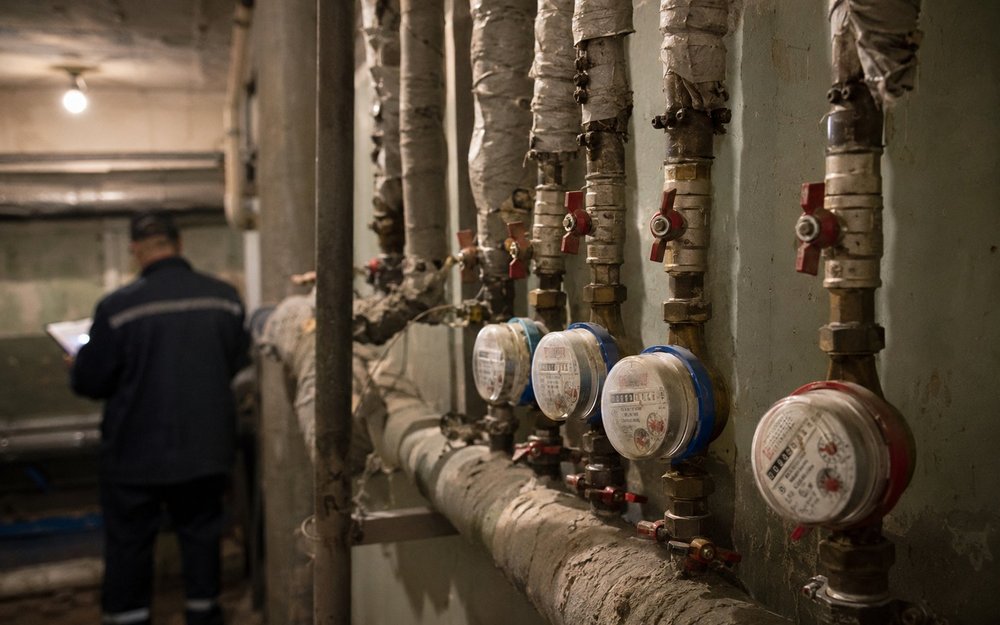
We establish the number of apartments, where the meters are, how the risers are arranged and what condition the existing meters are in. Without that it is impossible to prepare a realistic schedule.
We prepare a work schedule by riser or by stairwell, and a quote that reflects the size of the building.
We prepare a notice for residents about when the work will take place and how it will proceed. Clear information given in advance considerably reduces the number of unanswered doors.
We work to the schedule. For each apartment we prepare a certificate with the details and readings of the meter removed and the meter installed.
For apartments where there was no access, we plan a repeat visit and offer residents the option of arranging an individual time.
We hand over consolidated documentation: what was done, which meters were installed, where the work was not carried out and why.
Most of the problems in building-wide projects are not technical. They are organisational: residents have not been informed and do not answer the door, documentation reaches the property manager piecemeal and in different formats, and it is unclear which apartments have been left undone.
So we do not treat this work as a simple meter replacement multiplied by the number of apartments. The schedule, the communication and a single consolidated report are just as much a part of the job as the installation itself — and they are precisely the part the property manager would otherwise have to handle themselves.
The same approach works in office buildings, retail properties and other commercial sites where several metering points need replacing or individual tenants need separate metering. Describe the property in your request and we will put together a solution.
In almost every apartment building there is a difference between the reading on the building's incoming meter and the sum of the apartment meters. A small difference is normal. The problem starts when it becomes permanent and grows, because that difference ends up on residents' bills and raises questions the property manager has to answer.
The reasons vary. Some are technical: worn apartment meters no longer register small flows, so thin streams and dripping cisterns go unmeasured. Some are organisational: readings are submitted on different dates or not submitted at all, so the monthly figures are not comparable.
Replacing all the meters in a building at once does not resolve every one of these causes, but it removes the first and makes the data comparable — all the meters are the same age and in the same condition. That makes ongoing metering easier and makes the difference explicable.
The schedule is the part of the project that affects the outcome most. Working riser by riser is more efficient than working through apartment numbers, because it allows water shut-offs to be planned predictably and reduces the number of times residents are left without water.
The choice of times matters just as much as the order. Working only on weekdays in the middle of the day guarantees a large number of unanswered doors. It is more practical to combine: schedule some of the visits for the evening or at weekends, when most residents are at home.
We prepare the schedule after the survey and agree it with you before we begin. That means you know what you can announce to residents, and when.
In no building is it possible to reach every apartment on the first pass. Some residents are at work, some do not live there, some apartments are let out or empty. A project that does not plan for repeat visits simply passes that problem back to the property manager.
Our approach is to plan at least one repeat pass and to offer residents the option of arranging an individual time. That usually covers most of the apartments not reached initially.
For those that remain, you receive a specific list: which apartments, how many attempts were made and what the known reason is. That lets you decide what to do next, rather than having to work out for yourself what has been left undone.
For each apartment we prepare a certificate with the details, numbers and readings of the meter removed and the meter installed. It is the document that records the specific work and allows metering to continue correctly.
In addition we hand over a consolidated list for the whole building — what was done, which meters were installed, where the work was not carried out and why. We can adapt the format to your record-keeping system if it requires a particular structure. The aim is to save you retyping data from sheets of paper into your own system.
Describe the property — we will get in touch and arrange a survey.
Your request has been received. We will contact you as soon as possible.