We install new water meters at properties that do not have one yet, and we also fit additional meters. We assess the assembly, select the meter and carry out the installation.
Installation differs from replacement in that there has not been anything in the meter's place before, or a further metering point is being added. In practice this is most often needed in three situations.
The property has never had a meter. If you pay for water at a flat rate, an individual meter lets you pay for what you actually use. Whether that works out cheaper depends on your real consumption, but for most households metering is more accurate than a flat-rate calculation.
Renovation or rebuilding work is under way. If you are rebuilding the bathroom or the kitchen, fitting a meter or moving it somewhere more convenient is a logical step. It is simpler and cheaper to do at that point than later.
A separate metering point is needed. In commercial properties and in houses with several users, separate metering is sometimes required — for an individual tenant, for garden watering or for an outbuilding, for example.
We check whether the water supply assembly has the room and the technical means for a meter to be fitted.
We select a meter to suit the pipe diameter and the expected consumption.
We fit the meter into the pipework, adding shut-off valves and a filter if needed.
As agreed, we seal the meter and prepare the documents for submission.
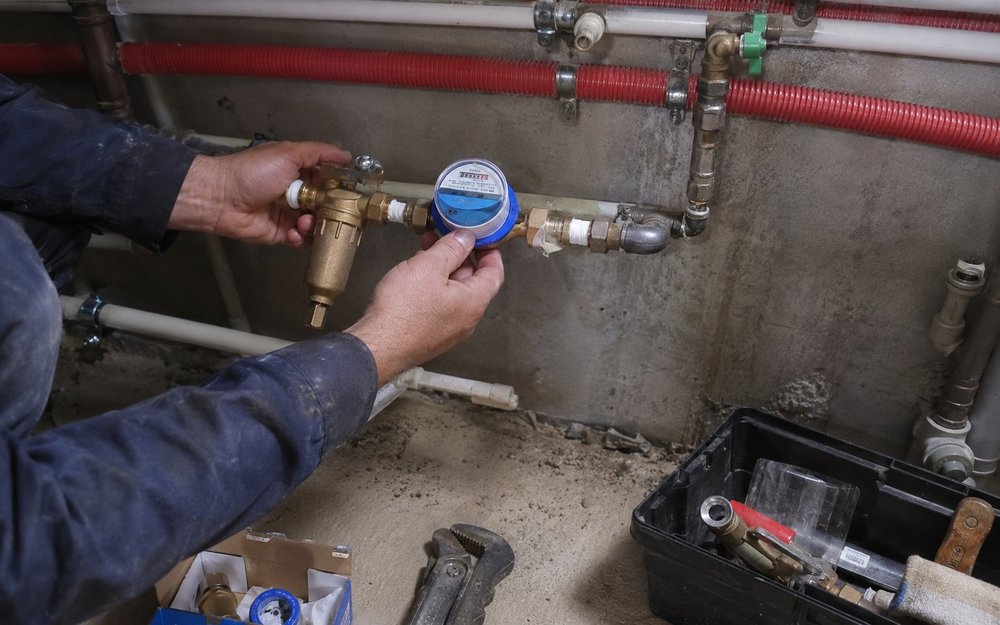
Installing a meter is not simply a matter of attaching a device to a pipe. For the metering to be correct and the meter to last, the mounting position and direction matter, as does whether there is a filter upstream of the meter to protect the mechanism from deposits carried by the pipework.
Shut-off valves matter too. If they are old or do not work, it is sensible to replace them at the same time as the meter is installed — any later work on the meter will otherwise be more difficult. We spot things like this during the assessment and tell you about them before we start work.
In apartment buildings there is also the property manager's procedure to consider — some buildings set specific requirements for installing meters and accepting them for billing. If you know your building's requirements, tell us about them in your request.
You fill in the form, we get in touch and establish the situation at the property. With an installation it is almost always worth looking at the assembly first.
We propose a solution, select a suitable meter and deliver it.
We fit the meter at the agreed time and check that it is watertight and working.
As agreed, we seal the meter and prepare the documents so that it can be accepted for billing.
If a meter is already in place and needs swapping for a new one — that is a replacement.
If there is no meter yet, or you need an additional metering point — that is an installation. If you are not sure, say in your request that you would like a consultation.
The meter itself is only one component. For the metering to be correct and the meter to last as long as it should, a small assembly usually forms around it, in which every element has its own job.
The shut-off valve upstream of the meter lets you cut off the water supply without isolating the whole riser. Without a working valve, any later work on the meter becomes harder and more expensive, so a faulty valve is almost always worth replacing at the same time.
The filter catches the fine particles, rust and sediment carried out of old risers. They are the most common reason meters wear out early, because they settle on the mechanism. A filter is a cheap component that protects a more expensive one.
The right mounting direction and orientation determine whether the meter measures accurately. Every meter body carries an arrow showing the direction of flow, and most models also have a permitted orientation — horizontal or vertical. Fitted the wrong way round or in the wrong orientation, a meter can read inaccurately from day one.
Choosing a meter is not a question of which one costs more or is better. What matters is that it suits the system. The pipe diameter at the connection point counts, as does the expected consumption and whether the meter is intended for cold or hot water — the two are not interchangeable, because a hot water meter is built for different temperatures.
The second factor is the fitting length and orientation. In older apartments space is often tight, and not every meter will physically fit. That is exactly why we look at the assembly first and only then propose a specific solution.
You do not need to know your way around any of these specifications. That is part of the service: we choose and deliver a meter that suits your system.
At properties that have never had a meter, there is not always a ready-made place to build one in. Sometimes the assembly has to be rebuilt, a straight length of pipe created, or an outdated connection part replaced. This is not unusual, particularly in older buildings.
In such cases, a survey before the work is not a formality but a necessity. It lets us say exactly what will need doing and avoids the situation where a technician arrives, finds the assembly unsuitable and the job is postponed.
If the survey shows that additional work is needed, we tell you straight away — before we agree a price, not part way through the job.
We will get in touch within 5 minutes of you submitting the form
Your request has been received. We will contact you as soon as possible.