Verification is carried out by an accredited laboratory. We arrange the whole process — we remove the meter, take it in for checking and install it again.
A water meter is a measuring instrument, and like any measuring instrument its accuracy can change over time. Verification is a metrological check carried out under laboratory conditions to establish whether the meter measures accurately enough to be used for billing.
It is important to understand that verification is not a visual inspection. It cannot be done on site in your apartment — the meter has to be removed and taken to an accredited laboratory that has the right equipment and the authority to carry out and certify such a check.
It is precisely the multi-stage nature of this process that makes it inconvenient. You have to find someone to remove the meter, work out where to take it, and then have someone install it again and seal it. We take over that whole chain.
We look at the meter and tell you whether verification makes sense or whether replacement would be better value.
We remove the meter and make sure the water supply is not cut off for the whole duration of the check.
The meter is taken to an accredited laboratory, which carries out the metrological check.
We install the meter again, seal it as agreed and prepare the documents.
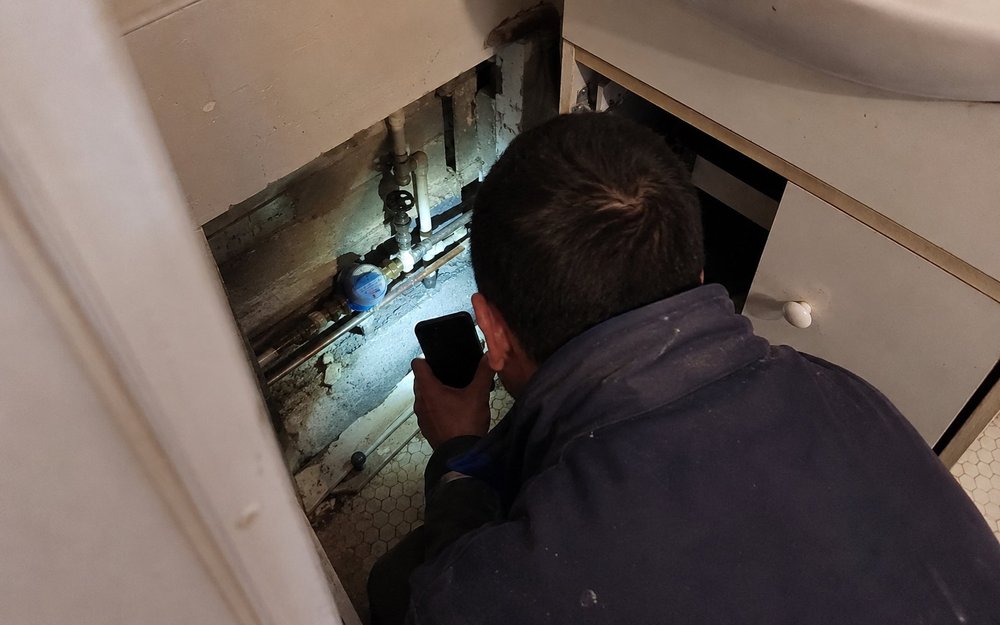
This is the question almost every customer asks, and there is no single right answer. In both cases the meter has to be removed and installed again, so the amount of work at the property is similar. The difference lies in what happens in between.
Verification keeps your existing meter, provided it passes the check. That can be sensible if the meter is relatively new and in good condition. The risk is that the meter fails, in which case it needs replacing anyway.
Replacement means a new meter of known condition with its full service life ahead of it. For older meters that is often the more practical route. Once we have looked at the meter, we tell you which option seems more sensible in your situation — and the final choice is yours.
The rules on water meter verification in Latvia have changed in recent years, and the exact procedure can differ depending on the type of property and on what your building's property manager requires. We do not interpret regulatory requirements on your behalf. If you have questions about what exactly applies to your building, we suggest checking them with your property manager or service provider — and we will carry out the work in line with what you have established.
In most cases a water meter is a mechanical device: the flow of water turns a rotor, and a gear train carries the movement to the dial. Every one of those parts wears over time. Bearings wear down, limescale and fine sediment from the mains settle on the components, and the resistance in the mechanism gradually increases.
The result is usually not dramatic, but it is systematic. A worn meter increasingly fails to register small flows — a thin stream or a slow drip, for example. That means part of the water used goes unrecorded, and the building's total consumption no longer matches the sum of the individual apartment meters.
That is exactly why metrological checking exists. It is not a formality but a way of confirming that the device your bill is calculated from still measures what it claims to.
During verification the meter is connected to a test rig that passes a precisely known quantity of water through it, and what the meter registers is compared against that. The check is carried out at several flow rates — high, medium and low — because it is low flow that usually shows up wear first.
This is also why verification cannot be done on site in an apartment. Without a reference rig there is nothing to compare against, and a device's accuracy cannot be judged by its appearance. A meter that looks fine may measure inaccurately — and the other way round.
The main question customers ask is a simple one: what happens to the water supply while the meter is away. The check does not take a few minutes, so a connecting piece or a temporary meter is usually fitted in place of the meter — the water supply keeps working.
This detail is worth agreeing in advance, because it affects both how the work is organised and how consumption is recorded in the meantime. We talk about it before we start work, not afterwards.
The second practical aspect is time. Verification means two visits — one to remove the meter and one to install it again. Replacement means one. It is worth bearing that in mind when planning the work.
There are situations in which we advise against even considering verification. If the meter is visibly damaged, if the dial is misted up or hard to read, if the body is cracked or if the meter has been frozen, the outcome of the check is easy to predict — and the money spent on it will have been wasted.
Verification is also rarely sensible for very old meters. Even if such a meter passes the check, it comes back into your system with exactly the wear it left with. In those cases the honest answer is to recommend replacement, and that is what we say.
We will get in touch within 5 minutes of you submitting the form
Your request has been received. We will contact you as soon as possible.